1. A silent but systemic disruption of the energy landscape
Between 2024 and 2026, the global low-carbon hydrogen market experienced a major inflection that challenges the trajectories anticipated at the beginning of the decade. Where forecasts assumed a linear rise of green hydrogen, the reality reveals a far more fragmented dynamic structured around three competing pathways.
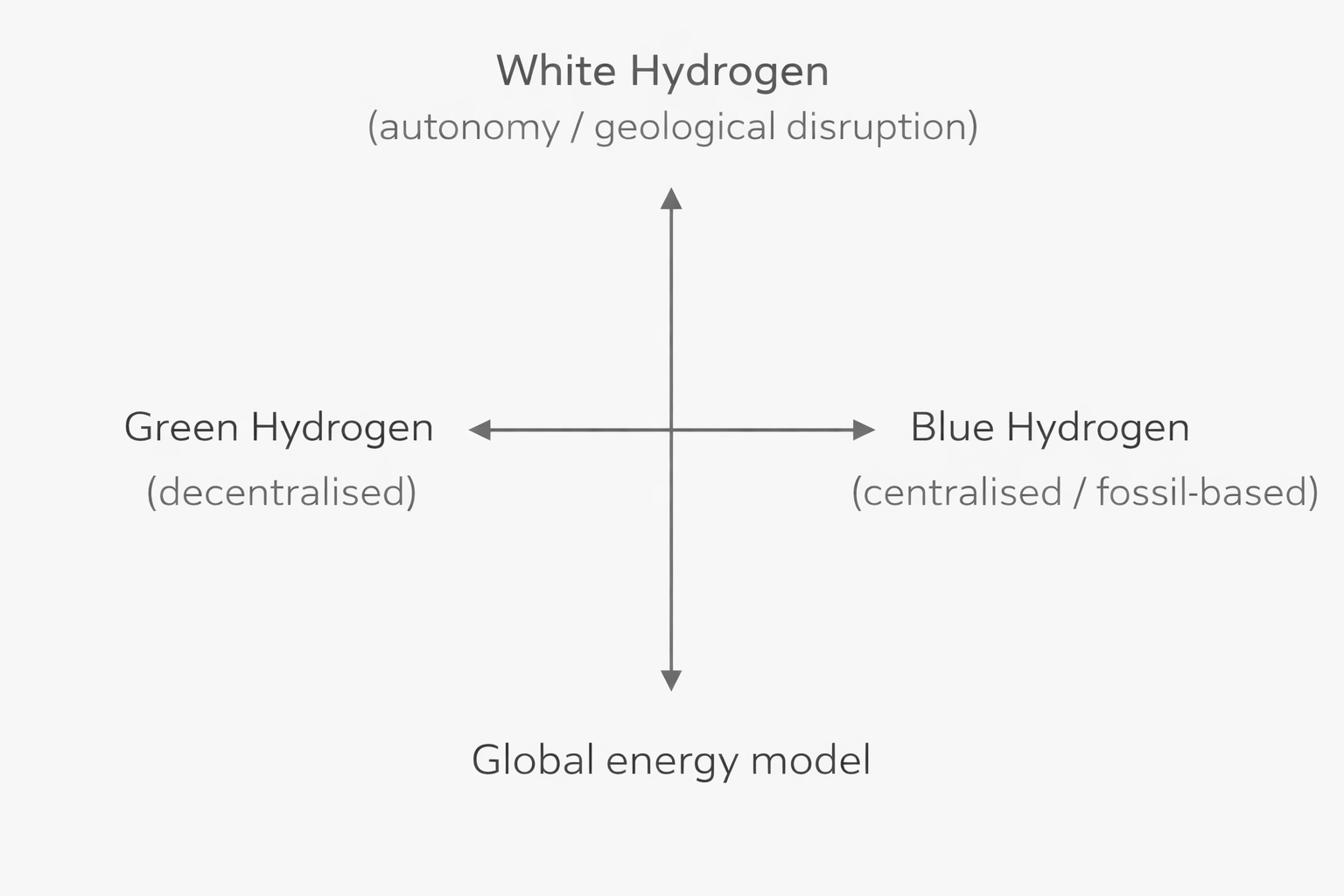
On one hand, blue hydrogen is emerging as a pragmatic extension of the existing gas model, allowing major hydrocarbon producers to preserve their influence. On the other hand, green hydrogen, despite being at the core of public policies, is struggling to reach large-scale industrialisation. Finally — and this is the most structural shift — the emergence of white hydrogen is profoundly reshaping the scarcity assumptions that have so far underpinned energy strategies.
This reconfiguration goes beyond a technological evolution: it is redefining geopolitical balances by introducing a new form of competition between centralised and decentralised energy production models.

2. White hydrogen: from scientific anomaly to geopolitical lever
Until 2023, natural hydrogen was largely considered a geological curiosity with no industrial potential. This assumption has been abruptly challenged by a series of converging discoveries worldwide.
The French case is a turning point. The identification of a major deposit in Lorraine, estimated between 46 and 92 million tons, positions France as a potential key player. Beyond its scale, this discovery is significant because it suggests that white hydrogen may be geologically widespread rather than exceptional.
Similar signals are emerging in the United States, Australia, Tanzania, and Albania, alongside a rapid rise in private actors specialised in exploration. This trend reflects a shift in perception: white hydrogen is no longer a scientific hypothesis but a strategic asset undergoing industrial validation.
3. Green hydrogen: constrained deployment due to structural limitations
Green hydrogen is facing a widening gap between political ambitions and industrial reality. Despite massive announcements, the rate of project completion remains extremely low.
4. Blue hydrogen: strategic consolidation of gas producers
Blue hydrogen is undergoing rapid consolidation, driven by countries with abundant gas resources. Leveraging established technologies, these actors deploy large-scale projects quickly, particularly in the Middle East.
5. Still immature and highly vulnerable supply chains
Hydrogen requires heavy infrastructure — pipelines, ports, specialised vessels — whose deployment remains significantly delayed. Export-oriented projects depend on complex logistics corridors exposed to geopolitical risks.
6. Critical hydrogen routes: a strained geography
Nearly 70% of future hydrogen and ammonia flows will depend on maritime or land routes exposed to high geopolitical risk.
7. A structuring energy trilemma
The rise of white hydrogen introduces a third pole, transforming the green vs. blue debate into a true trilemma.
8. Implications for decision-makers
Securing hydrogen supply becomes a structural competitiveness issue. Countries with white hydrogen potential should accelerate exploration. Import-dependent regions must secure logistics chains.
Conclusion
The low-carbon hydrogen transition is unfolding within a fragmented and competitive landscape. White hydrogen is the main source of uncertainty — and potentially disruption — toward 2030.
Contact the authors
Isabelle EL Tannouri
Romain Cochard
contact@eltan-rc.com